
Sharp corners and rigid geometry have dominated home design for decades, but there’s a shift happening. Curved lines are making a powerful comeback in interior spaces, transforming sterile rooms into welcoming sanctuaries. Arches, rounded furniture, and flowing architectural details create visual softness that straight lines simply can’t match. This isn’t just aesthetic preference, it’s about crafting spaces that feel instinctively comfortable and naturally inviting. Whether through a statement sofa or a custom archway, introducing curves into a home changes how occupants experience every room.
Table of Contents
ToggleKey Takeaways
- Curved lines in interior design create visual softness and psychological comfort by reducing the sterile, institutional feel of rigid rectangular spaces and triggering a natural human preference for safer, more inviting environments.
- Curved furniture like sectionals and round dining tables are the most accessible way to introduce curves, offering practical benefits such as improved flow, reduced collision hazards, and lower costs compared to architectural modifications.
- Strategic architectural curved elements including arched doorways, bullnose corners, and curved wall molding require more planning but deliver bold visual impact—always verify load-bearing walls and maintain code-required clearances before starting projects.
- The most effective interiors balance curves with straight lines using a roughly 70-30 ratio, preventing visual chaos while avoiding sterile minimalism through thoughtful integration rather than complete transformation.
- Curved elements work best when paired with solid, neutral-colored materials and used as focal points supported by simpler angular pieces, avoiding visual redundancy and maintaining visual hierarchy.
Why Curved Lines Are Transforming Modern Interiors
The design world has rediscovered what ancient architects knew intuitively: curves create harmony. From Roman arches to Art Deco flourishes, rounded forms have appeared throughout architectural history during periods emphasizing comfort and human-centered design. Today’s interiors are moving away from the stark minimalism that defined the 2010s toward warmer, more organic aesthetics.
Curved elements soften visual tension in ways that dramatically affect how a space feels. A room filled exclusively with rectangular furniture, ninety-degree corners, and linear shelving can feel institutional, even sterile. Introducing rounded shapes breaks that rigidity. An arched doorway draws the eye naturally through a space. A circular coffee table encourages conversation by eliminating the hierarchical “head of the table” dynamic.
From a practical standpoint, curves also improve flow in high-traffic areas. Rounded furniture edges reduce collision hazards (especially important in homes with children) and make navigation feel more intuitive. There’s a reason hotels and public spaces favor curved circulation paths, they guide movement without creating bottlenecks.
The resurgence isn’t limited to high-end designer showrooms. Accessible furniture retailers now offer curved sectionals and rounded dining tables alongside traditional rectilinear pieces, making the aesthetic achievable at multiple price points.
The Psychology Behind Curves: Creating Comfort and Flow
Human response to curved versus angular shapes isn’t merely cultural preference, it’s neurological. Research in environmental psychology shows that people consistently rate spaces with curved elements as more inviting and less threatening than those dominated by sharp angles. This response likely stems from evolutionary patterns: in nature, sharp angles often signal danger (thorns, broken branches, predator claws), while curves suggest safety (nests, caves, rolling hills).
When occupants enter a room, their brains process visual information rapidly, making snap judgments about safety and comfort. Curved lines register as approachable. They lack the aggressive “pointedness” that angular furniture can project. This is why waiting rooms, healthcare facilities, and hospitality spaces increasingly incorporate rounded seating and flowing architectural details, they reduce ambient stress.
Beyond psychology, curves literally improve circulation through spaces. The human eye follows curved lines more smoothly than it tracks angular paths. An arched passage or rounded wall guides attention and movement organically, creating what designers call “flow.” This becomes particularly valuable in open-plan layouts where defining zones without walls requires subtle visual cues.
For DIYers considering curved elements, it’s worth noting that this isn’t about eliminating all straight lines. Balance matters. A room with exclusively curved forms can feel disorienting or overly whimsical. The goal is integration, using curves strategically to offset the angular bones most homes are built on.
Where to Incorporate Curved Lines in Your Home
Introducing curves doesn’t require gutting a room. Strategic placement of rounded elements creates impact without overwhelming existing architecture. Start by identifying areas where visual softness would improve function or feel, then work outward.
Furniture with Curves: From Sofas to Statement Pieces
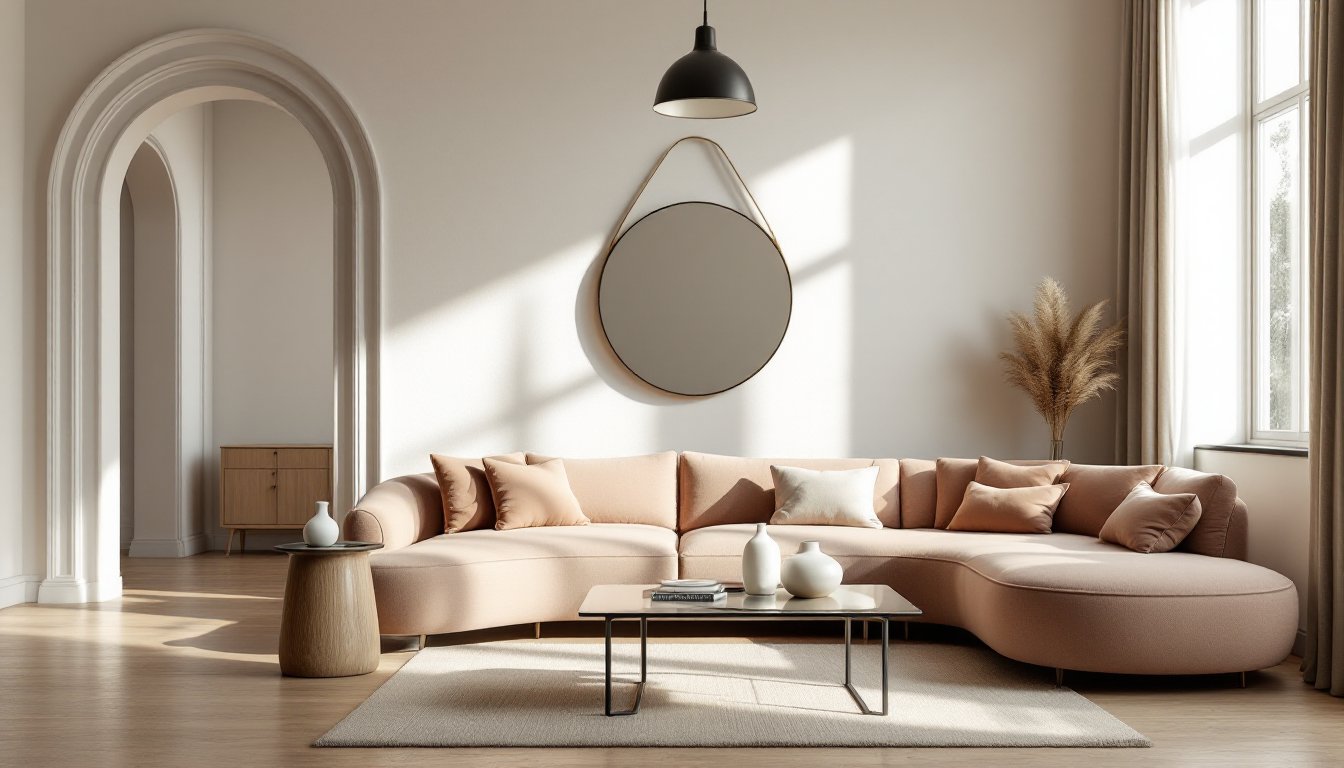
Furniture offers the most accessible entry point for curved design. Unlike architectural changes, furniture can be added, moved, or replaced without permits or contractors. Curved sofas and sectionals are currently the most popular choice, particularly barrel-back designs and semi-circular sectionals that create natural conversation zones.
When shopping for curved seating, pay attention to scale. A deeply curved sofa works beautifully in a spacious living room with ample wall space, but can overwhelm a compact area. Smaller spaces benefit from accent chairs with rounded backs or armless curved benches that provide shape without bulk.
Round and oval dining tables eliminate the awkward corner seats that rectangular tables create. They’re particularly effective in open-concept layouts where the dining area flows into the kitchen or living space. For families, rounded edges mean fewer bruised hips when someone squeezes past during dinner.
Don’t overlook smaller pieces. Rounded side tables, circular mirrors, and drum-style ottomans introduce curves without commanding attention. A kidney-shaped coffee table or semicircular console adds visual interest to transitional style spaces that blend traditional and contemporary elements.
One practical note: curved upholstery typically requires more fabric than equivalent straight pieces, which can increase costs by 15-30%. Custom curved sectionals may also have longer lead times since they’re less standardized than modular rectangular units.
Architectural Elements: Arches, Doorways, and Walls
Architectural curves make bold statements but require more planning than furniture swaps. Arched doorways and passages top the list for achievable DIY projects with professional results. Converting a standard rectangular doorway to an arch involves framing a curved header, then finishing with drywall or plaster.
For this conversion, homeowners will need:
- Flexible archway forms or a shop-built curved template (typically 1/4″ plywood or MDF bent to the desired radius)
- Drywall cut and dampened to bend around the curve (1/4″ drywall bends more easily than standard 1/2″)
- Joint compound and mesh tape for finishing
- Basic framing lumber (2x4s) to build out the arch structure
Safety note: Before cutting into any door framing, verify the wall isn’t load-bearing. Interior walls running perpendicular to floor joists are often non-structural, but always confirm with original building plans or a structural engineer. Load-bearing walls require a properly sized header beam, not a DIY judgment call.
Arch kits are available from home centers, offering pre-formed curves that simplify installation. These work well for standard door widths (30″, 32″, 36″) but custom openings require job-built solutions. Expect this project to take a full weekend for someone comfortable with drywall finishing. The curve itself isn’t difficult: achieving smooth, invisible seams requires patience and several coats of compound.
Curved accent walls represent a more advanced project. Creating a true curved wall from scratch involves either bending drywall around a framed radius (possible with 1/4″ panels and a tight curve radius) or using flexible materials like bendable plywood. Most designers recommend limiting curved walls to feature areas, a reading nook, a bar backdrop, or a hallway terminus, rather than attempting entire room perimeters.
For those not ready to commit to structural changes, curved wall molding and trim offer a compromise. Modern design trends emphasize these applied details, which create the suggestion of curves through surface treatments rather than altering the wall plane itself. Flexible polyurethane molding can form gentle arcs and is paintable to match trim.
Rounded corners throughout a home create subtle but pervasive softness. This involves using bullnose corner bead instead of standard 90-degree bead during drywall installation or renovation. It’s a small detail that disproportionately affects how refined a space feels. Bullnose corners also hold up better to impact damage, no sharp edges to chip or crack.
Code consideration: Archways and modified door openings must maintain minimum clearances per IRC standards (typically 80″ height, though this varies). Decorative arches that reduce the opening height below code minimums may fail inspection in habitable rooms.
Balancing Curves with Straight Lines for a Cohesive Look
The most successful curved-line interiors maintain tension between organic and geometric forms. Too many curves without anchoring straight lines creates visual chaos, like being inside a funhouse. The goal is thoughtful counterpoint, not complete transformation.
Start by assessing the room’s architectural bones. Most homes are built on a rectilinear grid: studs spaced 16″ on center, rectangular windows, perpendicular walls. These structural realities provide a framework that curves can play against. A curved sectional in a mid-century modern room works beautifully because it contrasts with the clean-lined case goods and rectangular windows typical of that style.
A practical ratio: aim for roughly 70% straight lines to 30% curves in most rooms. This isn’t a rigid formula, but it prevents tipping into either extreme. In practice, this might mean one curved sofa balanced with rectangular side tables and linear shelving, or a round dining table surrounded by angular cabinetry and straight-edged light fixtures.
Layering matters. If the room features a bold architectural curve, say, an arched entry or barrel-vaulted ceiling, furniture can lean more angular to avoid competing. Conversely, in a box-standard rectangular room, introducing multiple curved furniture pieces creates needed relief without overwhelming the space’s inherent structure.
Color and texture also influence how curves read in a space. Light, neutral tones on curved pieces allow the form itself to shine without visual weight. Bold colors or busy patterns on curved furniture can feel heavy because the eye has to process both the shape and the surface treatment simultaneously. This is why many contemporary design concepts favor solid-colored curved sofas in cream, gray, or muted earth tones.
For dining room layouts, pairing a round table with linear buffets or rectangular area rugs grounds the curve. The rug in particular serves as an anchoring element, a rectangular or square rug beneath a round table creates a visual frame that prevents the circular form from feeling unmoored.
Material selection reinforces balance. Smooth, flowing curves work best in upholstery, plaster, and painted finishes. Hard materials like stone, concrete, and wood grain often look more natural with straight cuts, though skilled fabricators can certainly execute curved work in these materials. Mixing material vocabularies, a curved velvet sofa beside a rectilinear wood coffee table, emphasizes each element’s distinct character.
One common mistake: matching every curve. If the sofa is curved, the coffee table doesn’t also need to be round, and the mirror doesn’t need to be circular. This creates visual redundancy. Instead, let one or two curved elements stand out, supported by simpler, straighter pieces that don’t compete for attention.
Conclusion
Curved lines shift how a space feels from the moment someone walks through the door. Whether through an arched entryway, a rounded sofa, or subtly bullnosed corners, these organic forms create warmth that straight edges alone can’t achieve. The key is integration, using curves to complement a room’s existing structure rather than fighting against it. Start with one statement piece or architectural detail, assess how it changes the room’s dynamic, then build from there. The result is a home that feels deliberately designed yet naturally comfortable.